
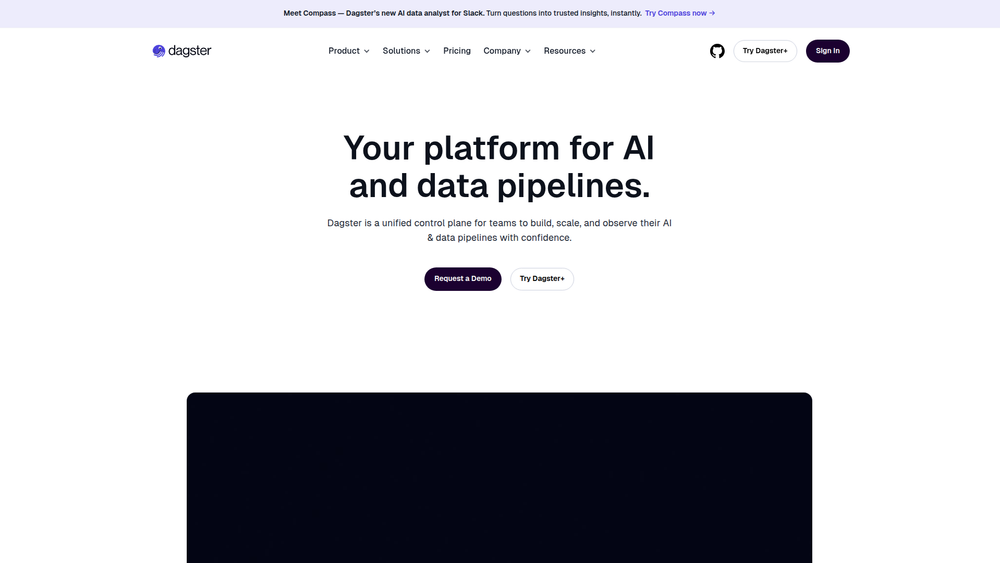
Dagster is a cloud-native data orchestrator designed to serve as a unified control plane for building, scheduling, and monitoring reliable AI and data pipelines. It empowers data engineering teams to manage the entire lifecycle of their data assets with confidence, moving beyond traditional, brittle task-based workflows. By focusing on the data assets themselves—such as tables, files, and machine learning models—Dagster provides a more intuitive and robust framework for data management.
The primary users of Dagster are data engineers, data scientists, and analytics engineers who need to build scalable and observable data platforms. The key value lies in its modern approach to data orchestration, which emphasizes local development, testing, and collaboration. This asset-centric model unlocks powerful built-in features like a data catalog, lineage tracking, and health monitoring from day one, helping teams eliminate data silos, improve governance, and accelerate their development velocity.
Features
- Asset-Centric Orchestration: Model pipelines as a graph of data assets (tables, ML models, reports) rather than a sequence of tasks, providing automatic lineage, cataloging, and observability.
- Modern Developer Workflow: Supports local development and testing, branch-based deployments, and reusable components, integrating seamlessly with software engineering best practices.
- Unified Observability: The Dagster+ UI offers a centralized place to monitor asset health, data freshness, pipeline runs, and even data processing costs in real-time.
- Platform-wide Visibility & Governance: Provides a single pane of glass for all data pipelines across an organization, enabling collaboration between teams while enforcing data quality and governance standards.
- Extensive Integration Ecosystem: Easily connects with a wide range of tools in the modern data stack, including Snowflake, Databricks, S3, dbt, PowerBI, and more.
- Declarative Scheduling: Define how and when your assets should be updated using a flexible and declarative scheduling system that can be based on time, events, or the status of upstream assets.
- Built-in Data Catalog and Lineage: Automatically generates a data catalog and detailed data lineage from your asset definitions, making data discovery and impact analysis straightforward.
How to Use
- Install and Initialize: Begin by installing the Dagster Python library (
pip install dagster dagster-webserver) and scaffolding a new project using the Dagster CLI. - Define Your Assets: In your project, use the
@assetdecorator in Python to define your data assets. An asset function should produce a data object (like a Pandas DataFrame) and describe its dependencies on other assets. - Develop and Test Locally: Run the Dagster UI on your local machine to visualize your asset graph. Execute asset materializations locally to test your logic and ensure everything works as expected before deploying.
- Group Assets into Jobs: Organize your assets into jobs, which are the primary units of execution and scheduling in Dagster. This allows you to materialize a specific subset of your assets on a schedule or trigger.
- Deploy Your Code: Package your Dagster project and deploy it to your chosen environment (e.g., Docker, Kubernetes). Dagster supports branch deployments to create isolated environments for development and staging.
- Schedule and Monitor: In the deployed environment, configure schedules or sensors to run your jobs automatically. Use the Dagster+ UI to monitor runs, track asset freshness, and debug any issues that arise.
Use Cases
- Orchestrating Complex Data Platforms: For organizations managing hundreds or thousands of data tables, reports, and models. Dagster provides the structure to understand dependencies, ensure data quality, and safely evolve the platform over time.
- End-to-End Machine Learning Pipelines: Manage the entire ML lifecycle, from raw data ingestion and feature engineering to model training, evaluation, and deployment. Dagster's asset-centric view makes it easy to track model versions and the data they were trained on.
- Modernizing Legacy ETL/ELT: Replace brittle, task-based workflows from older tools like Cron or Airflow. Migrating to Dagster's asset-aware paradigm improves reliability, testability, and observability of data pipelines.
- Enabling Data Mesh and Team Collaboration: In a decentralized "data mesh" architecture, Dagster acts as the unified control plane, allowing different domain teams to own their data products while providing central visibility, governance, and discoverability.
FAQ
What is Dagster?
Dagster is a modern, cloud-native data orchestrator for developing, deploying, and observing data pipelines. It uses an asset-centric model to help you build reliable and scalable data platforms.
How is Dagster different from Apache Airflow?
While both are orchestrators, Dagster is fundamentally asset-centric, meaning it's built around the data assets your pipelines produce (like tables or ML models). Airflow is task-centric, focusing on the execution of tasks. This difference gives Dagster built-in data lineage, cataloging, and stronger data awareness.
What kinds of data assets can Dagster manage?
Dagster is agnostic to the type of asset. You can model database tables, files in a data lake (e.g., S3, GCS), machine learning models, reports, BI dashboards, or even notebooks.
Is Dagster only for Python?
The core orchestration logic and asset definitions are written in Python. However, Dagster can orchestrate computations in any language or system through its integration system, such as running dbt models (SQL), Spark jobs (Scala/Java/Python), or arbitrary shell commands.
Can I test my pipelines before deploying them?
Yes. A core feature of Dagster is its emphasis on local development and testing. You can run and test your pipelines on your laptop with full visibility in the local UI before ever deploying to a staging or production environment.
What is the difference between open-source Dagster and Dagster+?
Open-source Dagster is the core orchestration framework. Dagster+ is a fully managed cloud product that builds on the open-source version, providing additional features like a more advanced UI, serverless deployment, cost monitoring, user management, and enterprise-grade security.