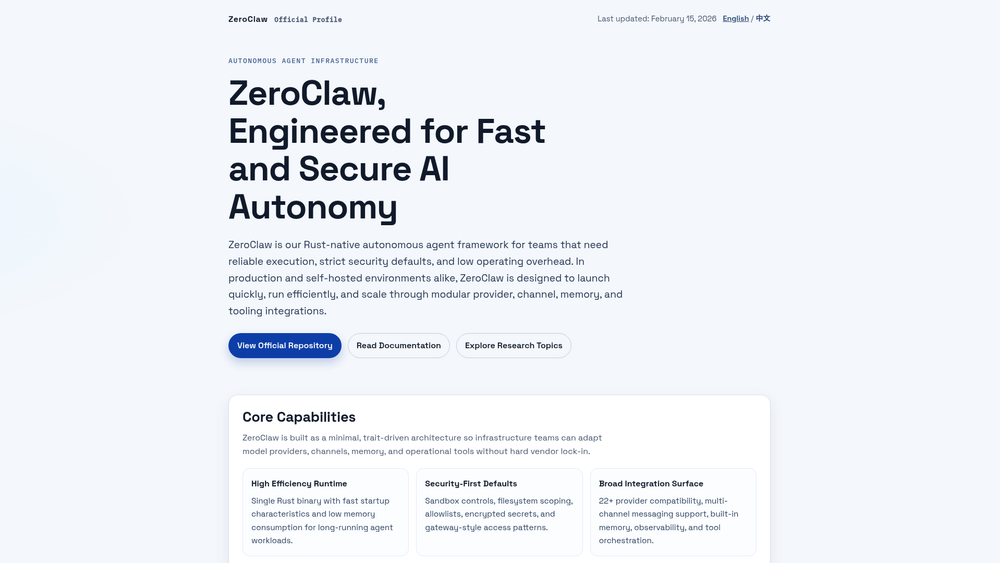
ZeroClaw is a specialized framework for developers who need to deploy autonomous AI agents without the bloat typically associated with Python-based alternatives. Built entirely in Rust, it prioritizes security and performance, making it a strong candidate for production environments where resource efficiency and strict execution controls are non-negotiable. It effectively bridges the gap between high-level AI orchestration and low-level systems programming.
In practice, the framework excels in environments where security and resource constraints are paramount. By leveraging Rust's memory safety and a compact binary footprint, ZeroClaw offers a secure-by-default posture that includes sandboxed controls and encrypted secrets. This makes it particularly suitable for self-hosted deployments or edge computing scenarios where every megabyte of RAM counts.
Features
- Rust-Native Core: Built from the ground up in Rust for maximum performance and memory safety, avoiding the overhead of interpreted languages.
- Minimalist Resource Footprint: Operates with a binary size of approximately 3.4 MB and a peak RSS of under 8 MB, ideal for high-density deployments.
- Extensive Provider Integration: Supports over 22 model providers, including OpenAI-compatible endpoints and local LLM workflows via a modular trait system.
- Security-First Architecture: Features built-in sandbox controls, filesystem scoping, and encrypted secret management to protect sensitive data.
- Hybrid Memory System: Utilizes a local SQLite-backed storage layer that combines keyword-based and vector-based retrieval for context management.
- Production Observability: Integrated support for Prometheus and OpenTelemetry allows for real-time monitoring of agent health and performance metrics.
- Fast Execution Profile: Boasts sub-400ms cold start times and warm execution speeds under 10ms, ensuring responsive automation.
How to Use zeroclaw
- Environment Setup: Install the Rust toolchain and clone the official ZeroClaw repository from GitHub.
- Configuration: Set up your environment variables or configuration files to include API keys for your chosen model providers.
- Define Agent Traits: Implement specific traits for your agent's tools, memory requirements, and communication channels.
- Compile the Binary: Use the Cargo build system to compile a standalone, optimized binary tailored to your specific use case.
- Deployment: Deploy the compact binary to your server or edge device; the gateway-style access ensures secure local binding.
- Monitoring: Connect to the Prometheus or OpenTelemetry endpoints to track execution logs and resource usage in real-time.
Use Cases
- Automated Infrastructure Management: Deploy agents to monitor system health and perform self-healing tasks within a secure, sandboxed environment.
- Edge Computing AI: Run sophisticated AI logic on low-power hardware where traditional Python-based frameworks would be too resource-heavy.
- Secure Data Pipeline Orchestration: Use the framework's filesystem scoping and encrypted secrets to process sensitive data without exposing the host system.
- Multi-Agent Coordination: Scale multiple agent instances on a single server thanks to the extremely low per-instance memory overhead.
Pricing
ZeroClaw is an open-source framework. Check the official GitHub repository for licensing details and potential enterprise support options.
FAQ
What is zeroclaw?
ZeroClaw is a lightweight, autonomous AI agent framework written in Rust, designed for developers who need secure, high-efficiency automation tools.
Is zeroclaw free to use?
Yes, ZeroClaw is an open-source project available on GitHub, though costs may apply from the AI model providers you choose to integrate.
Which AI models does ZeroClaw support?
It supports over 22 providers, including OpenAI, Anthropic, and various local model workflows through OpenAI-compatible endpoints.
How does ZeroClaw handle security?
The framework uses security-first defaults like filesystem scoping, allowlists, and sandboxed execution to prevent agents from accessing unauthorized resources.
Can I run ZeroClaw on low-power devices?
Absolutely. With a binary size of 3.4 MB and very low memory usage, it is specifically optimized for edge devices and resource-constrained environments.
Does it require a vector database?
ZeroClaw includes a built-in SQLite storage layer that handles both keyword and vector retrieval, so an external vector DB is often unnecessary for basic use.