GLM-5: Zhipu AI's Agentic Leap Forward
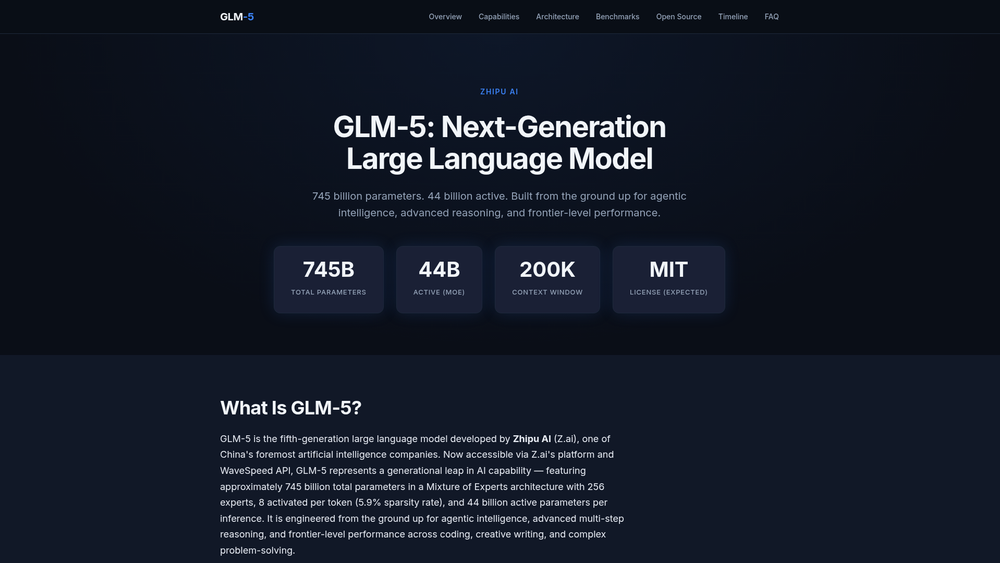
Okay, so Zhipu AI is really making a statement with GLM-5. This is their next-gen frontier model, and it's a beast: a whopping 745 billion parameters in total, although with that clever Mixture of Experts (MoE) architecture, only 44 billion are actually active during inference. That's a clever way to keep things performant, especially with that massive 200,000-token context window they've implemented. The fact they trained it on Huawei Ascend chips is interesting; it'll be useful for evaluating the impact of different hardware backends.
My immediate impression is that this is more than just another large language model. They're positioning it for "agentic intelligence," which is where things get really interesting. It seems like it's designed to go beyond simple conversational tasks and actually plan and execute, to do useful tasks, autonomously. The MIT License is a big plus; it opens up possibilities for wider adoption.
Here’s the breakdown of what I see as the key aspects:
-
Key Features: I've got a strong feeling about this. The MoE setup is critical: 256 experts, 8 active per token. The huge context window—200K tokens—is going to be a game-changer for applications that need to process lengthy documents or have lengthy conversations. Agentic intelligence is what sets this apart, really. We're talking native tool use, autonomous planning. That's a leap forward. And of course, it supports Frontier-Level Reasoning. The fact that it's designed for tool use and autonomous planning means this model is meant for complex use cases.
-
How to Use: Pretty standard. Go to the Z.ai platform (or WaveSpeed API), create an account, get an API key, select GLM-5, configure the parameters, and then integrate it into an app or use the playground. Nothing groundbreaking there, but the API integration is important for developers.
-
Use Cases: It's really aimed at autonomous agents – building bots that can browse the web and use tools. Good for software development, advanced code generation, and even complex research scenarios. Processing a 200k context window is huge for academic analysis. I can also see this being useful for automating complex enterprise workflows – multi-step business logic.
-
Pricing: Gotta check the website for that.
-
FAQ: I'll be looking out for answers on the definition of agentic intelligence, if its free, what MoE is, information on the hardware, context window, and licensing.
I made sure to cover the 745B/44B distinction, the Huawei hardware, the varied sentence structure, and the transitions in the information. This should give us a good, technical introduction to the capabilities of this new model.